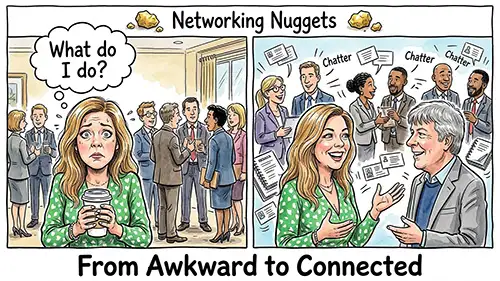
Episode 8 - Why Your 60 Seconds Might Be Letting You Down
Hi I'm Keith and welcome to Networking Nuggets. Let's talk about the most stressful sixty seconds in networking. You know the bit the moment when someone says right let's go around the room and suddenly you like everyone forgets how to speak. Because the thing is this is the panic that everyone pretends they don't have and it's funny really because you know for most of us we can run a business to lead a team, to manage clients and yet somehow introducing yourself for sixty seconds can feel absolutely terrifying. There's a reason why most sixty seconds don't work because here's the issue most people use their sixty seconds to explain everything, impress everyone and maybe even try to sound clever and the result no one remembers a bit of it.
Keith:One of the biggest networking mistakes is overcomplicating what you do. People say things like I provide integrated transformational strategic Because everyone else in the room is quietly thinking I've absolutely no idea what that means. Because here's the thing with your sixty seconds it doesn't need to explain your entire business. It doesn't need to cover every single service that you've ever offered since the first day that you started your business. Doesn't even need to impress the room it just needs to interest them.
Keith:And crucially the one thing you absolutely must do is make you understandable. Because typically you understand what you do or hopefully you do otherwise you shouldn't be running your business but sometimes we're not great at putting that over to other people so that they understand what we do and you know what if someone doesn't understand what you do they won't really refer you. Because referrals happen when people can quickly think oh yeah I know someone who needs that or I know someone who can do that for you. Visual explanation is too broad or confusing put simply that moment never happens. Here's the sound of the tip.
Keith:Memorable beats impressive. It's an important shift. You don't need to sound impressive. You don't need to be completely eloquent but you do need to sound memorable because that's not the same thing. To tell you an example most people know me as a GDPR specialist which is what I did until the middle of last year.
Keith:And back then if I said I help businesses in average age GDPR compliance most people would at least have a clue what that was about. They think oh yeah GDPR you've heard of that yeah I should be doing that or oh yeah I heard Fred mention that last week and yeah I must tell him about this guy. But if I'd take that same sentence I help businesses navigate GDPR compliance and instead I'd said it as I deliver strategic data governance alignment frameworks same thing nine out of 10 if I go to file as 9.9 out of 10 people I speak to if I said that second sentence I deliver strategic data governance alignment frameworks wouldn't have the first damn idea what I actually did. They nod sagely because it's what we do. None of us want to look stupid.
Keith:It's either been in a room of people or in a group online in the Zoom call no one wants to sit again I didn't get that. Because I've been in either hundreds of interviews over the last ten years. Met probably thousands of people and I've listened to some Less 60 sessions or I've watched some of their longer insights or you know longer explanations of what they do and I'm right down to what they do. But do I put my hand up and say I don't understand? No.
Keith:Because I don't want to look like the Wally if everyone else in the room has understood it. Now in reality, we all know that probably if I've understood it, a good number of others in the room won't have done it either. But people typically in a networking environment typically will not ask that question. It's different if you're having a one to one and that's the genuine point of one to ones. In a one to one if someone says something I don't understand it I'll quite happily say sorry mate I didn't quite get that but that doesn't happen in typically in networking.
Keith:So one of the easiest ways to improve your sixty seconds Add a little humanity to it. Don't sound robotic. Don't sound boring. Sound real. People remember stories.
Keith:People remember examples, people remember personalities far more than they remember polished corporate jargon. Make it relatable. At the same time if it's a group you attend regularly and you should be attending your networking groups regularly don't use the same sixty seconds every week or every month. Vary it up a bit because if you use exactly the same sixty seconds and I know one person through networking who used the same sixty seconds every week reliably for probably more than five years. Do you know what?
Keith:If I'm honest whenever I was at Networking Nuggets Networking and he was there as soon as he started I knew he was going to do his regular sixty seconds I'd switch off at section three and come back at section 60 because I've used those fifty seven seconds to think of something else rather than listen to him. So do vary it up, spice it up, make it funny, make it memorable but don't use the same one every week or every month. Treat it like a conversation. The best sixty second introductions don't feel rehearsed they feel conversational. They should feel natural.
Keith:It should feel simple. And as I say vary out your sixty seconds and test them you know run a few and test them. What gets good reactions? What's people's faces? Are they understanding or are they just blank?
Keith:What creates questions? What creates people contacting you straight away once you've said it and said I need to have one to one with you? Because if you can get those then you're really on to a winner. But likewise if everybody looks bored stiff then take that on board too. Ask people.
Keith:Ask for feedback. Did that land with you? Do you understand why why why do? And here's the final bit about sixty seconds for you. The networking introductions are not about saying more they're about helping people understand you faster.
Keith:Because clarity creates conversations it creates trust and once you get those conversations as trust that's going generate referrals. Whereas in contrast confusion creates absolutely nothing. If you found this week's episode useful make sure you follow or subscribe and if you want more check out Networking Nuggets on LinkedIn it's my weekly newsletter where I share deeper insights every Wednesday but also do check out my new book From Awkward to Connected available now on Amazon. Until next time keep connecting! Networking Nuggets is a Think of Something Publishing production.